OMG! How cute is that. And the kitten has good taste in fabric also. (I had Tumblr-savior-ed “cats” but this one slipped through the cracks and I’m not sorry.)
I decided to try to make an analysis of Tolkien’s fanfictions in AO3:
What is the AO3:
Archive of Our Own (AO3) is a nonprofit open source repository for fanfiction contributed by users. The site was created in 2008 by the Organization for Transformative Works and went into open beta in 2009. As of 2017, Archive of Our Own hosted over three million works in over 24,600 fandoms. The site has received positive reception for its curation, its organization, and the design of the site, mostly done by readers and writers of fanfiction.
First the number of fanfictions in the FFN (another site that since the launch of AO3 had its use diminished, it was mainly used in the first decade of the century):
Here the AO3 stats:
We can see that most of the fanfictions are about The Hobbit, so we will now analyze only the other Tolkien fandoms:
– The Lord of the Rings:
– The Silmarillion and other histories of Middle-Earth :
It’s fascinating. Thanks so much for sharing! I still cannot imagine how The Hobbit could inspire more fanwork than LotR or The Silmarillion! (Seriously. I do know. It’s those awful Peter Jackson Hobbit films! There is no accounting for taste. Just joking–everybody should enjoy whatever it is they enjoy.)
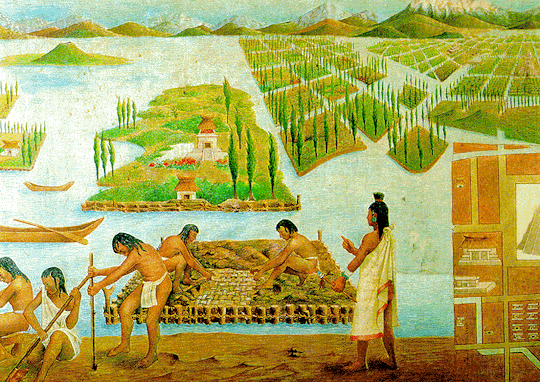
How on earth would you feed a city of over 200,000 people when the land around you was a swampy lake? Seems like an impossible task, but the Aztec managed it by creating floating gardens known as chinampas, then they farmed them intensively.
These ingenious creations were built up from the lake bed by piling layers of mud, decaying vegetation and reeds. This was a great way of recycling waste from the capital city Tenochtitlan. Each garden was framed and held together by wooden poles bound by reeds and then anchored to the lake floor with finely pruned willow trees. The Aztecs also dredged mud from the base of the canals which both kept the waterways clear and rejuvenate the nutrient levels in the gardens.
A variety of crops were grown, most commonly maize or corn, beans, chillies, squash, tomatoes, edible greens such as quelite and amaranth. Colourful flowers were also grown, essential produce for religious festivals and ceremonies. Each plot was systematically planned, the effective use of seedbeds allowed continuous planting and harvesting of crops.
Between each garden was a canal which enabled canoe transport. Fish and birds populated the water and were an additional source of food. [x]
This is literally so cool. Not only does it contribute to spacial efficiency, but the canals would easily keep pests, weeds, and possibly even diseases out of the respective plots. Companion planting and bio-intensive planting would be so much easier. Water-wise systems would be inherently present. Plus it looks so super neat aesthetically. I am just all about this.
Indigenous civilizations invented sustainable development way before there was a term for it.




 Heartofoshun's place